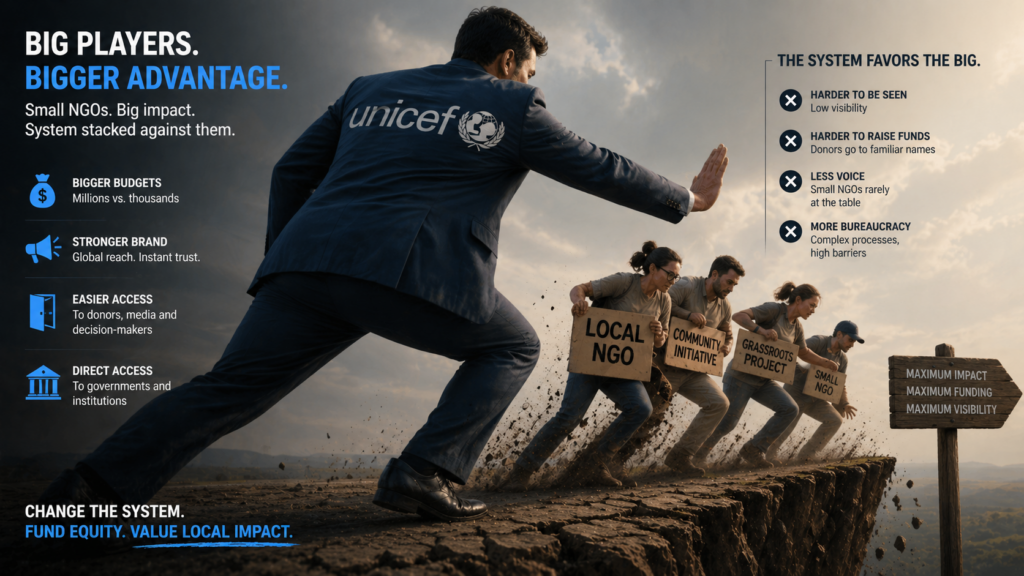
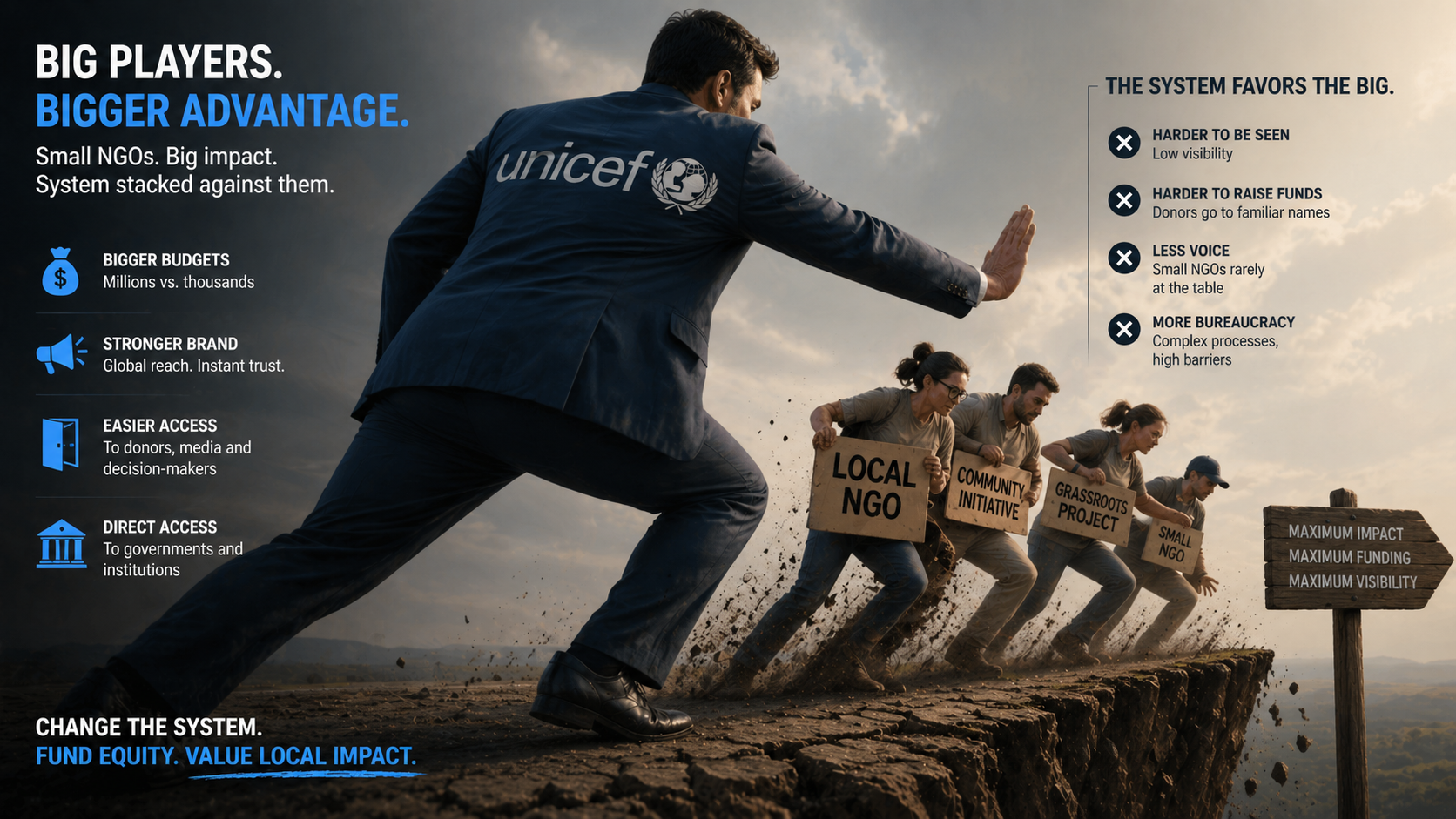
Are you tired of watching heartbreaking ads featuring crying children while the reality behind the scenes reeks of elitism and inefficiency? Let’s look at how the world of “Big Aid” works on a global scale. It is a world where compassion has been turned into a commodity, and where small, aggressive NGOs are crushed under the wheels of this gluttonous machine.
1. Administrative Behemoths: Where does your money actually go? They talk about aid, but in reality, it’s about maintaining the apparatus. Giants like UNICE* or certain U*N agencies are world record holders in burning money on themselves. The statistics are ruthless: it is not uncommon for up to 70% of every dollar you send to be swallowed by administration, lavish executive bonuses, marketing campaigns, and the logistics of their own existence. Your dollar shrinks to pennies on its way to a child in need, while a director in Geneva or New York shakes hands with celebrities.
2. NGO Apartheid: If you’re not in “The Club,” you’re invisible Try approaching a major donor as a small, innovative organization. The answer? Silence. Or they throw a bureaucratic wall at you that even a top-tier lawyer couldn’t climb. Donors prefer “proven names.” Why? Because it’s safe. They’d rather give millions to a foundation that eats it up in “consulting fees” than risk it on someone new with real solutions. A small NGO has no history? Tough luck. No partners in parliament? We don’t care. It’s a digital Middle Ages—feudal lords dividing the territory, leaving you not even the crumbs.
3. Haiti and Other “Gold Mines” of Failure Look at global disasters. After the earthquake in Haiti, billions were raised. The result? The Red Cr*ss and similar giants built a handful of houses while hundreds of millions “dissolved” into internal costs. Local small organizations that actually knew the terrain received alms or nothing at all. The big players arrived like colonial masters in white SUVs, took their photos, and retreated to their air-conditioned headquarters.
4. The “Inbox” Filter: Delete, Forget, Ignore In these corporate charities, emails aren’t read for their content. They are read based on who the sender is. If you aren’t from their “coffee-shop bubble” or don’t have a recommendation from high places, your project is deleted before it ever reaches someone with actual competence. It is the industrial liquidation of innovation. They don’t need you to solve the problem—they need the problem to persist, because problems generate grants.
5. Parasiting on Ideas The worst part? When a small NGO finally gets a word in, the big players often simply steal their ideas. They copy-paste your unique system, slap their logo on it, use their billion-dollar PR contacts, and suddenly they are the “innovators.” You are left without funding or recognition, while they collect awards at black-tie galas.
Conclusion: We’ve had enough. We refuse to play the role of extras in their theater. While they spend another few million on a poverty conference in a five-star hotel, we will be in the streets, in the code, and in the real world. We are building a system that doesn’t need their approval. We are building a network where aid isn’t a business, but a duty.
We’re going in hard. Against a system that pretends to help while only feeding its own belly.