
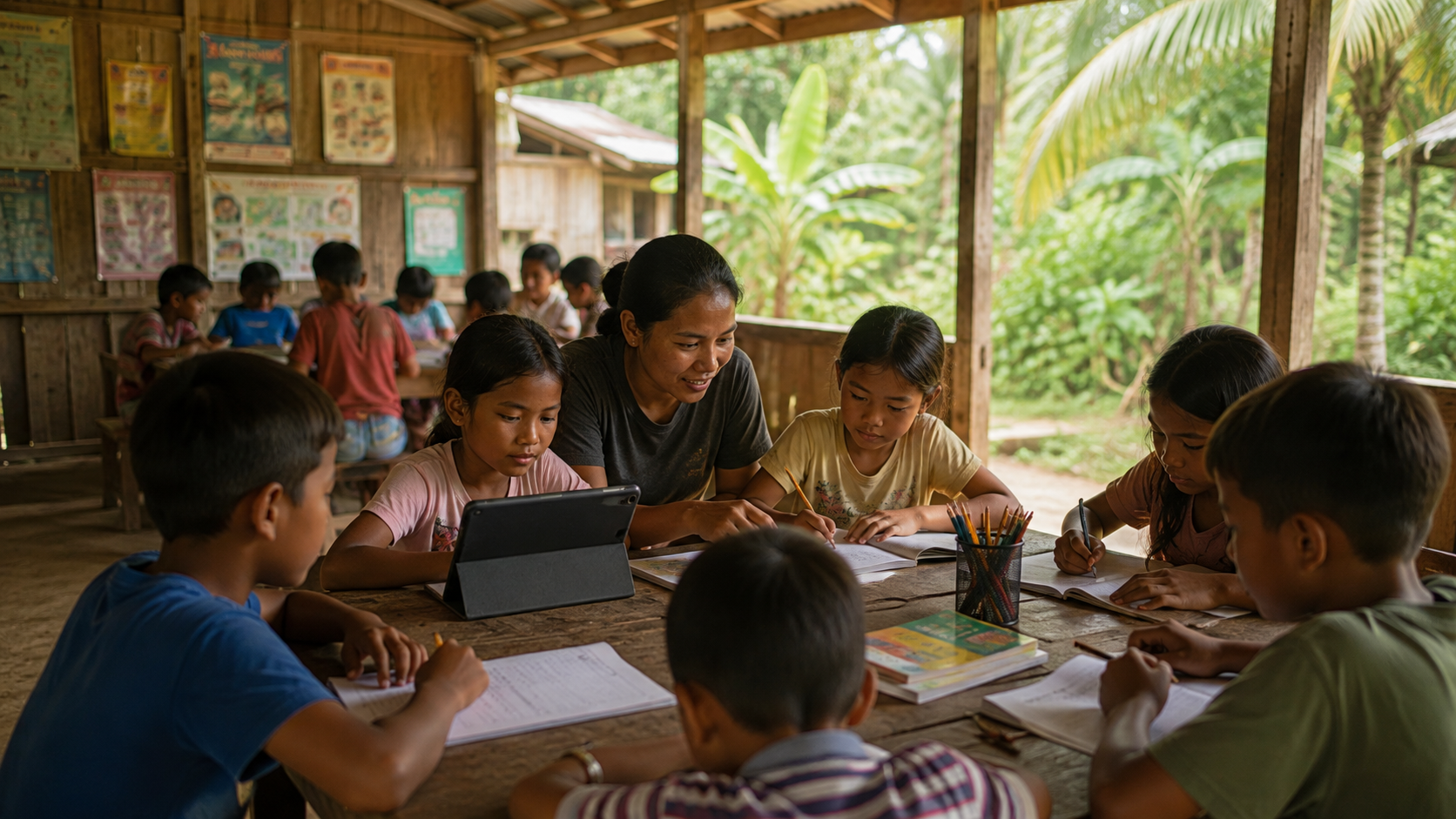
Angelus – Cahaya Anak is preparing the next phase of EduAI by Angelus, an AI-supported education system designed to bring quality education to children and young people whose access to conventional schooling is severely limited by poverty, geographic isolation, or inadequate infrastructure.
EduAI was not created as a technology experiment. It grew out of experience with the conditions in which children live in different parts of the world, and from one simple question:
How can we bring quality education to a child even where conventional educational infrastructure is insufficient — or does not exist at all?
The system is being designed so that artificial intelligence does not simply provide answers. Instead, it should help a child understand what they are learning, explain concepts in ways adapted to their needs, and support their gradual educational progress.
Technology is not intended to replace teachers or human interaction. People remain an essential part of the entire model.
An important part of the design is also the ability to operate in environments with limited or no internet connectivity. A child should be able to continue learning even where reliable daily internet access cannot be taken for granted.
Preparing the First Pilot
Before the pilot itself begins, we are planning an approximately eight-month pre-implementation phase.
Its purpose is not to arrive with a finished solution and simply deploy it. The first step is to understand local conditions, the educational environment, the needs of children and communities, and to build relationships with the people and institutions that understand the local reality best.
Reality first. Technology second.
This principle is fundamental to the way we want to build EduAI.
During the pre-implementation phase, we aim to identify a suitable community for the first pilot, document local conditions and infrastructure, consult with local professionals, and prepare an implementation model that respects educational, cultural, and social environment.
The Pilot Is Not Where We Begin Thinking About EduAI
EduAI is pre-pilot, not pre-concept.
The technological, educational, and ethical framework of the project already has a clear direction. The purpose of the pilot will be to bring that system into contact with the real world, understand what reality teaches us, identify challenges that cannot be discovered through system design alone, and address them before any wider deployment.
We are not using the pilot to discover what EduAI should be. We are using it to confront a carefully designed system with reality, identify what reality teaches us, and solve those challenges before wider deployment.
The Ambition Is Global
The long-term ambition of EduAI by Angelus is to create an education system capable of respecting different languages, cultures, and educational systems while maintaining a common technological and ethical foundation.
We cannot predict today everything that the first pilot will teach us.
And that is precisely why we need it.
EduAI was not born behind a desk. It was born from the reality of the field. And it is in the field that we intend to continue building it.